-
Gratings
-
Press-locked gratings
- Press-locked gratings
- Sun shading press-locked gratings
- Balustrades and fencing in press-locked gratings
- Corten steel gratings
- Facade boarding press-locked gratings
- Grating T3A
- Heavy load gratings
- Industrial floors and floorings in press-locked gratings
- Load table
- Press-locked in aluminium
- Stainless steel press-locked gratings
- Staircase steps in press-locked gratings
- Stock program
- Press-welded gratings
- Full gratings
- Rubber gratings
- Structure polyester
- FRP gratings
- Safety grids
- Gratings for shelving
- Rubber gratings
- Louvred gratings
- Spiral staircases
- Special gratings
- Fastening systems and accessories
-
Press-locked gratings
-
Usage
- Decoration
- Industry and building
- Materials and treatments
- Standards and safety
- References
- JK Technic today
- Customer area
- News
- Contact
Treatments
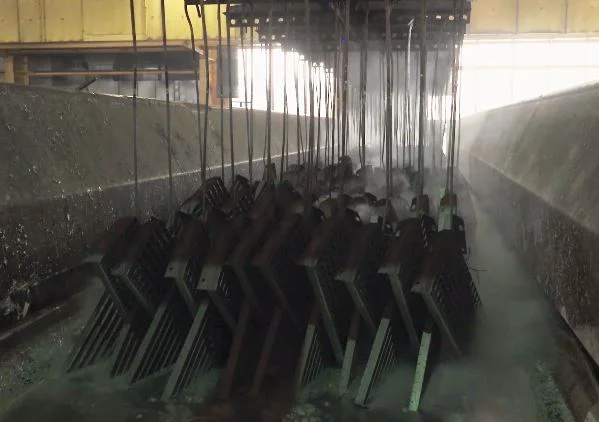
Galvanizing
Hot dip galvanizing is used to protect steel gratings against corrosion.
Dipped in a bath of molten zinc at approximately 450°C, the grating's resistance to moisture ingress is enhanced, extending its service life.
The reference standard for hot dip galvanizing is NF EN ISO 1461.
Powder Coating
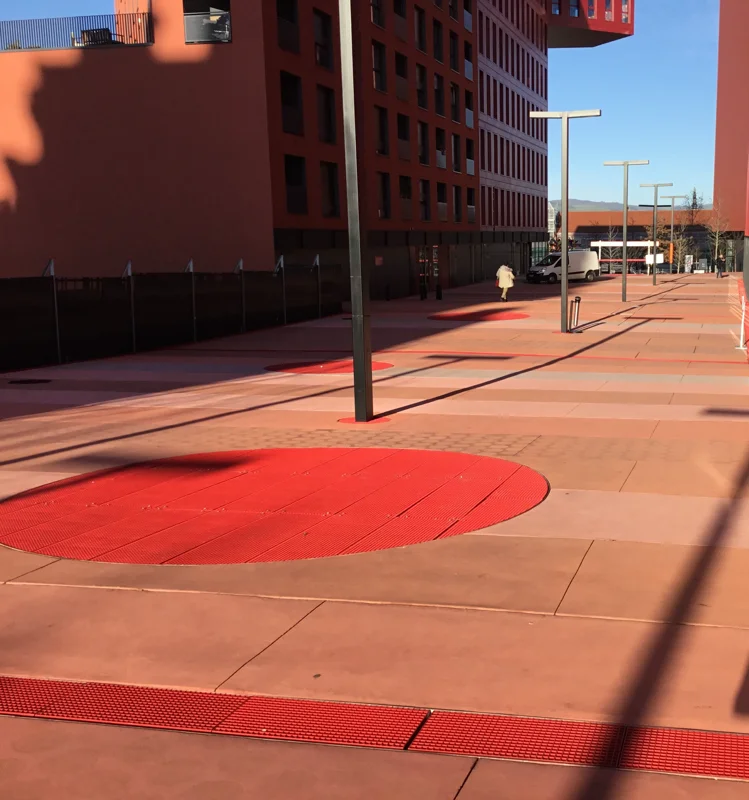
A finish consisting of applying a powder paint to the grating, then curing it in an oven at 200°C to bond the paint.
Powder coating offers a wide range of colours and provides uniform, durable finishes on metal gratings (gloss, matt, textured, etc.).
Combining aesthetic and design qualities, powder coating is popular in the architectural sector.
Cataphoresis (E-coat)
Cataphoresis is an industrial coating process that allows paint to be applied uniformly to metal parts.
The technique involves immersing the grating in a water-soluble paint bath, with the part connected as the cathode. The paint particles suspended in the bath migrate to the metal surface via an electric current. The paint then deposits evenly across the entire surface of the immersed part. Finally, the paint is drained and polymerised in an oven at approximately 180°C.
Cataphoresis is also known as electrophoretic coating, cationic electrodeposition or KTL (from the German Kathodische Tauchlackierung).
Widely used in the automotive industry, it also finds applications in other sectors such as aeronautics and construction.
Abrasive Blasting
Abrasive blasting (sandblasting or shot blasting) is a projection technique used to deep-clean a material by removing surface layers (rust, oxidation, welding residues…).
Passivation
Passivation is a process that forms a protective layer on the surface of a metal to slow its rate of corrosion. This layer acts as a barrier between the metal and its environment, protecting it from external attack.
In addition to corrosion resistance, passivation improves the appearance of gratings.
Anodising (or Eloxation)
Treatment specific to aluminium.
Anodising is an electrochemical treatment that creates an oxide layer on the surface of the aluminium grating (an electrically insulating layer of 5 to 50 micrometres).
This process provides improved resistance to wear, corrosion and heat.
Electropolishing
Treatment specific to stainless steel.
A process that simultaneously polishes and passivates a stainless steel grating. The electropolished or polished stainless steel thus achieves a smooth surface with excellent corrosion resistance.
Advantages of the various treatments
Treatments | Advantages |
|---|---|
Cataphoresis (E-coat) | Protects against corrosion and provides good mechanical and chemical resistance |
Galvanizing | Improved resistance to impact and corrosion |
Powder Coating | Forms a protective, aesthetic and durable coating; available in a range of colours |
Abrasive Blasting | Removes rust, mill scale and other surface contaminants |
Passivation | Produces a clean surface protected against corrosion |
Anodising | Makes aluminium grating more resistant to wear and corrosion |
Electropolishing | Makes the stainless steel grating surface smooth and corrosion-resistant |
JK Technic Commercial Service
+33 3 87 98 88 76
Technical characteristics
Assembly
Uses
Information

20 000 customers in Europe, many references.
Browse our gallery of references in industry and architecture.
Discover our gallery